RS / THE REVENUE SPECIALIST
HARBORLANE OPS / SAMPLE / ILLUSTRATIVE DATA ONLY | 1
HARBORLANE OPS / SAMPLE REPORT
GTM Readiness Scan
Prepared for the founder and leadership team | 28 September 2026
Gretchen Phillips | Founder, The Revenue Specialist
Your next sales decision
Can you move beyond founder sales? Not yet.
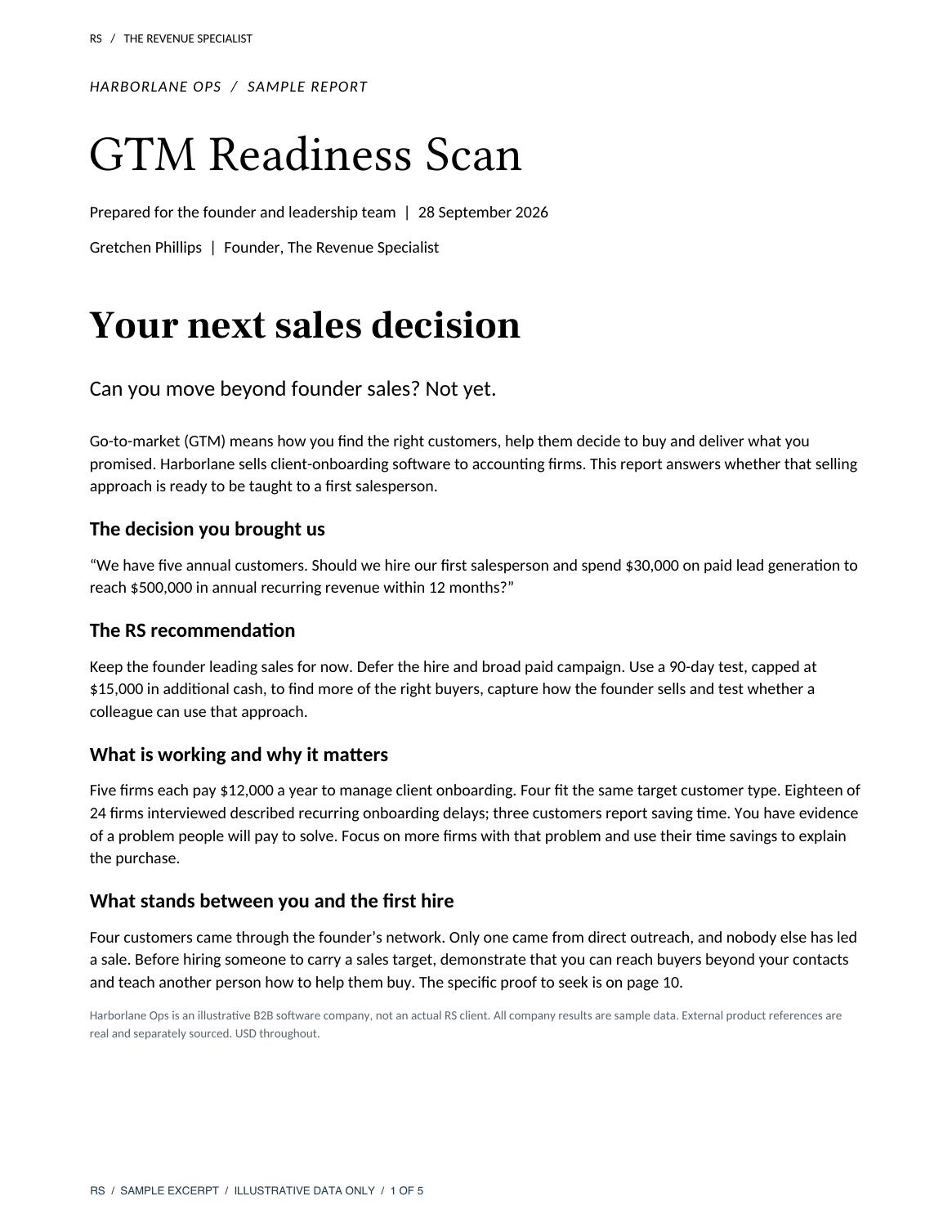
Go-to-market (GTM) means how you find the right customers, help them decide to buy and deliver what you
promised. Harborlane sells client-onboarding software to accounting firms. This report answers whether that selling
approach is ready to be taught to a first salesperson.
The decision you brought us
“We have five annual customers. Should we hire our first salesperson and spend $30,000 on paid lead generation to
reach $500,000 in annual recurring revenue within 12 months?”
The RS recommendation
Keep the founder leading sales for now. Defer the hire and broad paid campaign. Use a 90-day test, capped at
$15,000 in additional cash, to find more of the right buyers, capture how the founder sells and test whether a
colleague can use that approach.
What is working and why it matters
Five firms each pay $12,000 a year to manage client onboarding. Four fit the same target customer type. Eighteen of
24 firms interviewed described recurring onboarding delays; three customers report saving time. You have evidence
of a problem people will pay to solve. Focus on more firms with that problem and use their time savings to explain
the purchase.
What stands between you and the first hire
Four customers came through the founder’s network. Only one came from direct outreach, and nobody else has led
a sale. Before hiring someone to carry a sales target, demonstrate that you can reach buyers beyond your contacts
and teach another person how to help them buy. The specific proof to seek is on page 10.
Harborlane Ops is an illustrative B2B software company, not an actual RS client. All company results are sample data. External product references are
real and separately sourced. USD throughout.
RS / SAMPLE EXCERPT / ILLUSTRATIVE DATA ONLY / 1 OF 5
RS / THE REVENUE SPECIALIST
HARBORLANE OPS / SAMPLE / ILLUSTRATIVE DATA ONLY | 7
07 / GTM READINESS SCAN
Three findings that change the decision
Keep selling to the right customers and make the founder’s approach teachable.
1 Your best customers give you a useful starting point
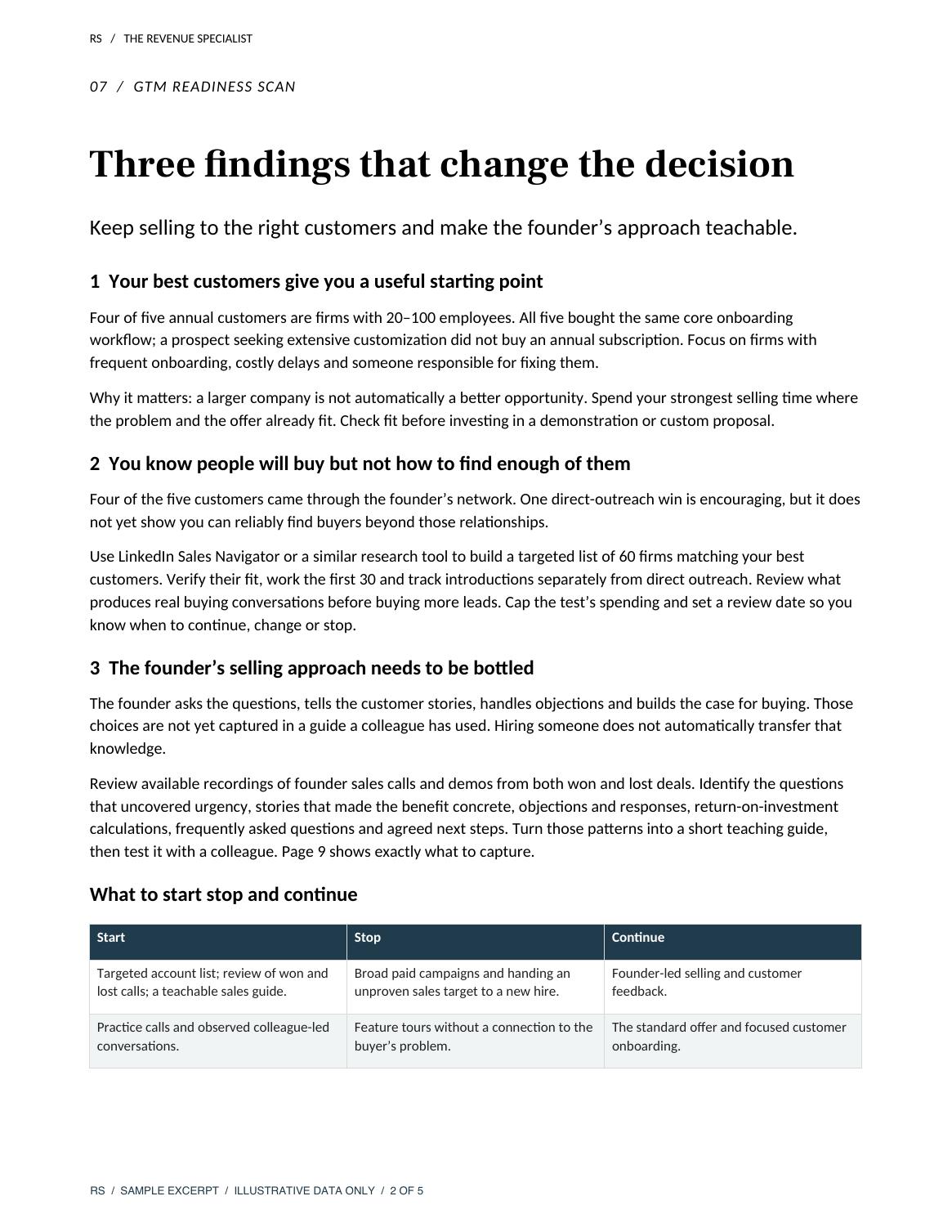
Four of five annual customers are firms with 20–100 employees. All five bought the same core onboarding
workflow; a prospect seeking extensive customization did not buy an annual subscription. Focus on firms with
frequent onboarding, costly delays and someone responsible for fixing them.
Why it matters: a larger company is not automatically a better opportunity. Spend your strongest selling time where
the problem and the offer already fit. Check fit before investing in a demonstration or custom proposal.
2 You know people will buy but not how to find enough of them
Four of the five customers came through the founder’s network. One direct-outreach win is encouraging, but it does
not yet show you can reliably find buyers beyond those relationships.
Use LinkedIn Sales Navigator or a similar research tool to build a targeted list of 60 firms matching your best
customers. Verify their fit, work the first 30 and track introductions separately from direct outreach. Review what
produces real buying conversations before buying more leads. Cap the test’s spending and set a review date so you
know when to continue, change or stop.
3 The founder’s selling approach needs to be bottled
The founder asks the questions, tells the customer stories, handles objections and builds the case for buying. Those
choices are not yet captured in a guide a colleague has used. Hiring someone does not automatically transfer that
knowledge.
Review available recordings of founder sales calls and demos from both won and lost deals. Identify the questions
that uncovered urgency, stories that made the benefit concrete, objections and responses, return-on-investment
calculations, frequently asked questions and agreed next steps. Turn those patterns into a short teaching guide,
then test it with a colleague. Page 9 shows exactly what to capture.
What to start stop and continue
Start Stop Continue
Targeted account list; review of won and
lost calls; a teachable sales guide.
Broad paid campaigns and handing an
unproven sales target to a new hire.
Founder-led selling and customer
feedback.
Practice calls and observed colleague-led
conversations.
Feature tours without a connection to the
buyer’s problem.
The standard offer and focused customer
onboarding.
RS / SAMPLE EXCERPT / ILLUSTRATIVE DATA ONLY / 2 OF 5
RS / THE REVENUE SPECIALIST
HARBORLANE OPS / SAMPLE / ILLUSTRATIVE DATA ONLY | 8
08 / GTM READINESS SCAN
Three priorities in order
Find the right buyers, qualify them carefully and teach what works.
First Build and work the right account list
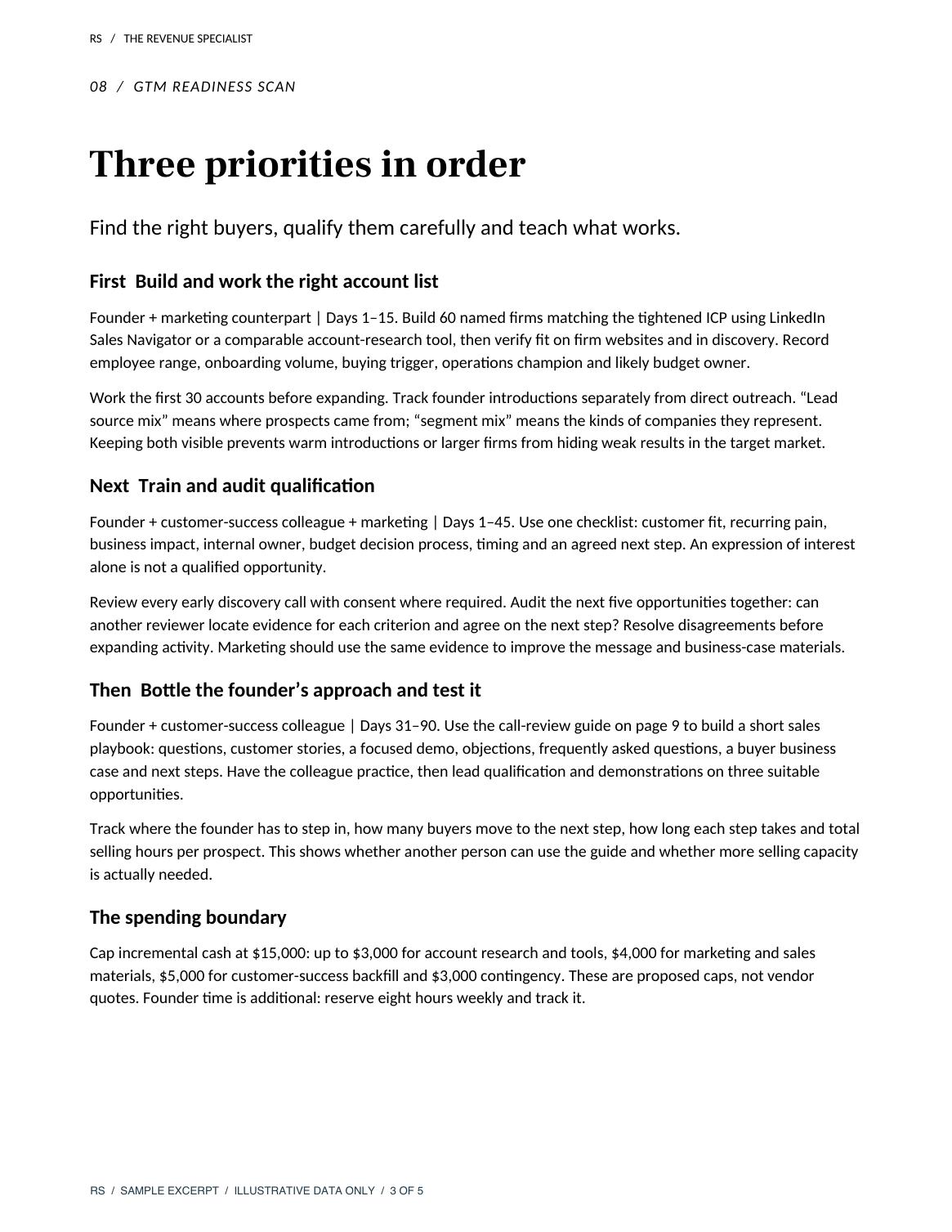
Founder + marketing counterpart | Days 1–15. Build 60 named firms matching the tightened ICP using LinkedIn
Sales Navigator or a comparable account-research tool, then verify fit on firm websites and in discovery. Record
employee range, onboarding volume, buying trigger, operations champion and likely budget owner.
Work the first 30 accounts before expanding. Track founder introductions separately from direct outreach. “Lead
source mix” means where prospects came from; “segment mix” means the kinds of companies they represent.
Keeping both visible prevents warm introductions or larger firms from hiding weak results in the target market.
Next Train and audit qualification
Founder + customer-success colleague + marketing | Days 1–45. Use one checklist: customer fit, recurring pain,
business impact, internal owner, budget decision process, timing and an agreed next step. An expression of interest
alone is not a qualified opportunity.
Review every early discovery call with consent where required. Audit the next five opportunities together: can
another reviewer locate evidence for each criterion and agree on the next step? Resolve disagreements before
expanding activity. Marketing should use the same evidence to improve the message and business-case materials.
Then Bottle the founder’s approach and test it
Founder + customer-success colleague | Days 31–90. Use the call-review guide on page 9 to build a short sales
playbook: questions, customer stories, a focused demo, objections, frequently asked questions, a buyer business
case and next steps. Have the colleague practice, then lead qualification and demonstrations on three suitable
opportunities.
Track where the founder has to step in, how many buyers move to the next step, how long each step takes and total
selling hours per prospect. This shows whether another person can use the guide and whether more selling capacity
is actually needed.
The spending boundary
Cap incremental cash at $15,000: up to $3,000 for account research and tools, $4,000 for marketing and sales
materials, $5,000 for customer-success backfill and $3,000 contingency. These are proposed caps, not vendor
quotes. Founder time is additional: reserve eight hours weekly and track it.
RS / SAMPLE EXCERPT / ILLUSTRATIVE DATA ONLY / 3 OF 5
RS / THE REVENUE SPECIALIST
HARBORLANE OPS / SAMPLE / ILLUSTRATIVE DATA ONLY | 10
10 / GTM READINESS SCAN
Your 90 day roadmap
Make each review a decision about evidence, not a deadline to declare victory.
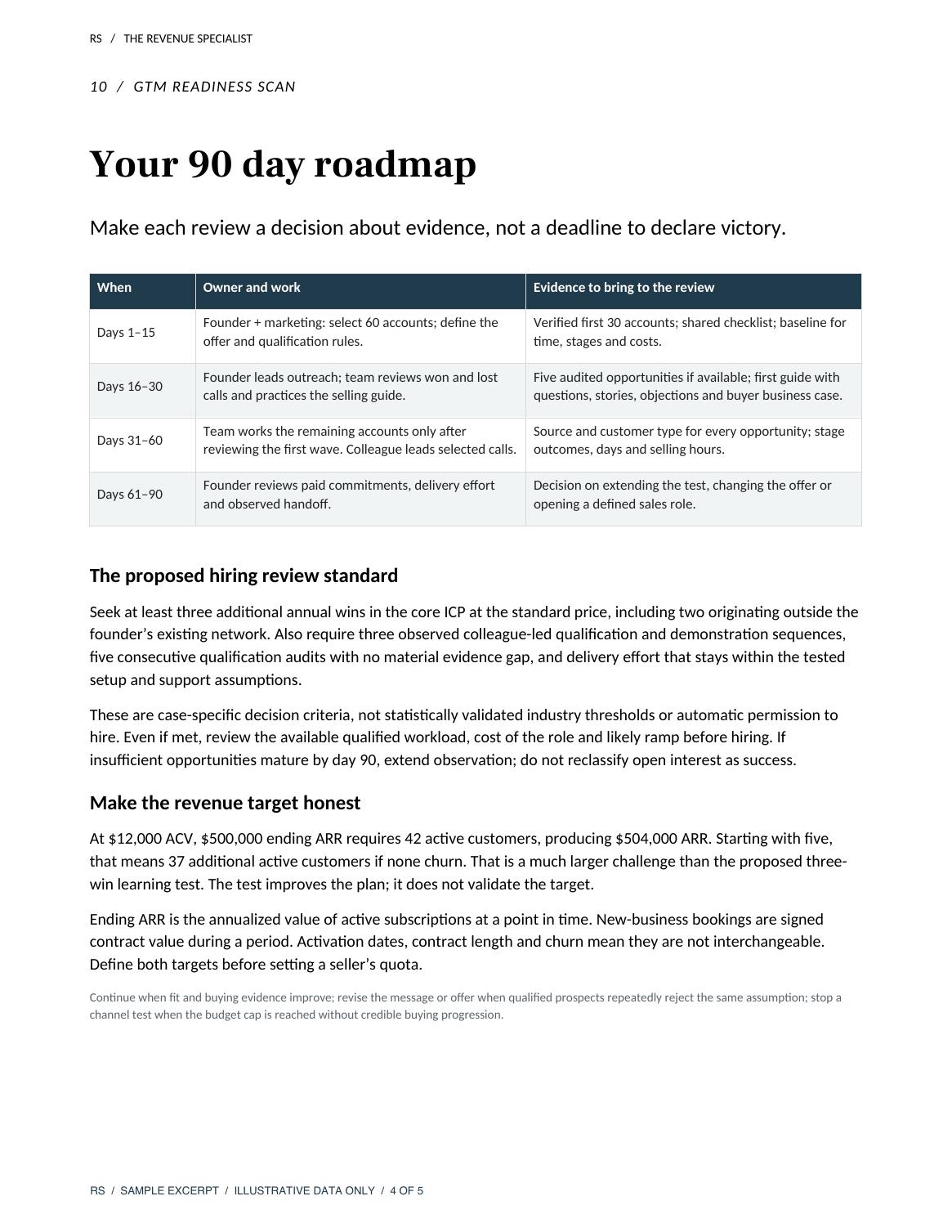
When Owner and work Evidence to bring to the review
Days 1–15 Founder + marketing: select 60 accounts; define the
offer and qualification rules.
Verified first 30 accounts; shared checklist; baseline for
time, stages and costs.
Days 16–30 Founder leads outreach; team reviews won and lost
calls and practices the selling guide.
Five audited opportunities if available; first guide with
questions, stories, objections and buyer business case.
Days 31–60 Team works the remaining accounts only after
reviewing the first wave. Colleague leads selected calls.
Source and customer type for every opportunity; stage
outcomes, days and selling hours.
Days 61–90 Founder reviews paid commitments, delivery effort
and observed handoff.
Decision on extending the test, changing the offer or
opening a defined sales role.
The proposed hiring review standard
Seek at least three additional annual wins in the core ICP at the standard price, including two originating outside the
founder’s existing network. Also require three observed colleague-led qualification and demonstration sequences,
five consecutive qualification audits with no material evidence gap, and delivery effort that stays within the tested
setup and support assumptions.
These are case-specific decision criteria, not statistically validated industry thresholds or automatic permission to
hire. Even if met, review the available qualified workload, cost of the role and likely ramp before hiring. If
insufficient opportunities mature by day 90, extend observation; do not reclassify open interest as success.
Make the revenue target honest
At $12,000 ACV, $500,000 ending ARR requires 42 active customers, producing $504,000 ARR. Starting with five,
that means 37 additional active customers if none churn. That is a much larger challenge than the proposed three-
win learning test. The test improves the plan; it does not validate the target.
Ending ARR is the annualized value of active subscriptions at a point in time. New-business bookings are signed
contract value during a period. Activation dates, contract length and churn mean they are not interchangeable.
Define both targets before setting a seller’s quota.
Continue when fit and buying evidence improve; revise the message or offer when qualified prospects repeatedly reject the same assumption; stop a
channel test when the budget cap is reached without credible buying progression.
RS / SAMPLE EXCERPT / ILLUSTRATIVE DATA ONLY / 4 OF 5
RS / THE REVENUE SPECIALIST
HARBORLANE OPS / SAMPLE / ILLUSTRATIVE DATA ONLY | 11
11 / GTM READINESS SCAN
Gretchen’s Take
Your next investment should make a successful sale easier to repeat.
You have something worth working on. Five businesses have moved beyond encouragement and committed to an
annual purchase. The next task is to understand precisely why they bought, make that case clearer and find more
companies with the same need.
I would keep you close to selling for this next phase. That is appropriate founder work: learning the buyer’s
language, the real approval path and which promises the product can consistently fulfill. I would bottle your
approach: review recordings of wins and losses, capture the questions, customer stories, objections and business
cases that helped buyers decide, and teach those choices to someone else.
Put your best people on your best opportunities. Build a deliberate prospecting list and spend your time on firms
with recurring pain, a responsible buyer and a business case. High-value activity means helping a qualified buyer
make a sound decision—not collecting meetings with people who are curious.
Bring marketing into the learning loop. They should understand qualification, listen to the buyer’s questions and
hear where the message does or does not resonate. They need to explain what the software does for the target
buyer, what problem it solves and why the purchase is worth making.
At the 90-day review, I would want to see a more teachable sales process, additional customers won for the same
reasons, and evidence that the founder does not need to rescue every step. If those are present and the workload
supports it, we can design the first sales role around a real job with a realistic path to success.
Gretchen Phillips
Founder, The Revenue Specialist
Optional 15 minute Q&A
Use the included optional conversation to clarify the diagnosis, pressure-test the first action or discuss what
evidence would change the hiring recommendation. Bring your most important decision; this is a focused report
discussion, not a full implementation workshop.
If you want help with the next step
The $2,500 RS design engagement builds on your Scan to turn an agreed priority into a company-specific solution.
Depending on your needs, that could include a sharper customer profile and buyer messaging, qualification criteria
and sales stages, or a teachable sales playbook. We agree the specific deliverables and scope before you commit.
Implementation and ongoing advisory are scoped separately.
Apply your $100 Scan credit within 30 days of the date your report is sent, bringing the $2,500 fee to $2,400. Reply
to your delivery email to explore the fit; there is no obligation to continue.
This sample presents an illustrative advisory perspective for Gretchen Phillips’s review. It does not represent advice delivered to an actual Harborlane
leadership team.
RS / SAMPLE EXCERPT / ILLUSTRATIVE DATA ONLY / 5 OF 5